
Bristol, Albion
Fear and loathing in suburbia

I live on a suburban street in south Bristol where very little happens. The community convenes mostly on WhatsApp and the Ilchester Crescent feed is self-replenishing, the tone toggling from earnest and generous to brusque and beseeching. Small talk takes place here, not along the sinuous coil of tarmac that makes up the crescent. Either that or my neighbours are avoiding me.
A while ago, as I was stretching, preparing for a run, a lovely man who lives next door—Hungarian, I think—gave me a pull-up bar and told me how to install it. A nice gesture, though I’ve never used it.
Further along, there’s one of those quaint miniature libraries that looks like a bird box, where you can pick up trashy, battered airport novels and leave a book you’ve finished with. Another neighbour operates what she calls “the egg shack”—this is fairly self-explanatory, but she fills it with eggs laid by hens I’ve never seen, and sometimes fresh produce from either her garden or an allotment (tomatoes, green beans, that kind of thing). I find this peculiar little shop, which runs on trust and amity, very sweet, and in my more sentimental moments, genuinely poignant. But I never have cash on me so I’ve never bought anything.
My neighbours don’t tarry around the post box or gossip in the corner shop, but everybody is friendly and polite and friendliness and politeness are expected. It’s quiet here, sometimes pleasantly so; in other moments it can be a bit suffocating and empty. My flat is on top of a hill and I can see half the city from my bedroom window.
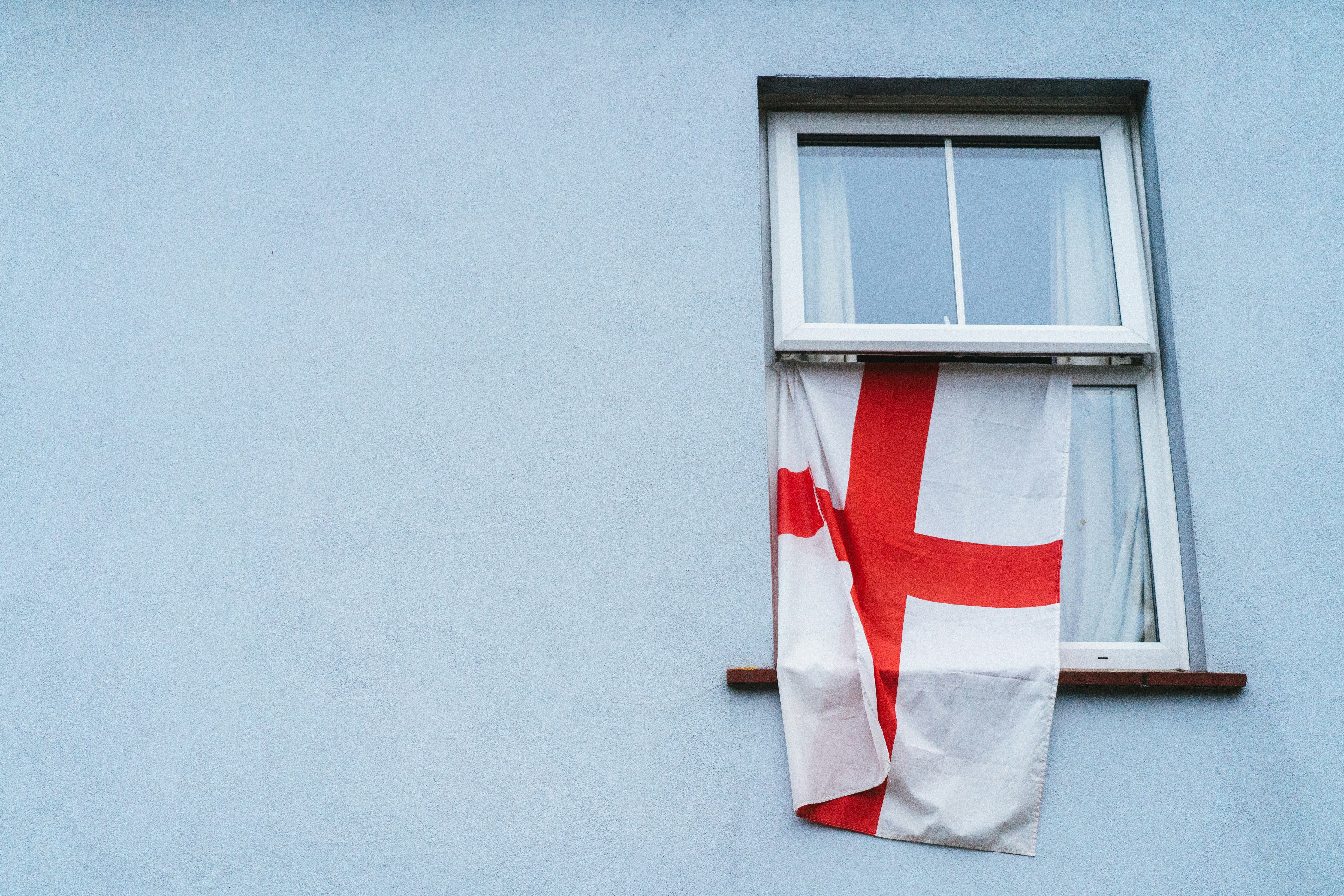
Something has changed since I moved here almost three years ago, though. Beyond the terraced houses and the overwhelming atmosphere of primness and good will; down the road, past the cat I love, whose name I don’t know and whose owner I’ve never met, there are three main streets which lead—respectively—towards the centre of town, down to Ashton Gate football stadium and Cumberland Basin, and out into the Somerset countryside. And each of these thoroughfares is trimly flanked by St George’s flags and Union Jacks. They’re arranged in doubles, one above the other, on each and every lamppost or bus stop, for about a mile in every direction.
The stark red cross is twinned with the campy, geometric jumble of the Union flag as though they meant similar things. They don’t, though.
Walking beneath them, I feel uneasy even as I glance up reflexively. The motif repeats and redoubles, producing a steady staccato rhythm, and I’m pulled back to them again and again, counting as I go. It’s the England flag, in particular, that’s discomfiting.
(For all its imperial baggage, the Union Jack has been softened and ironised by pop culture—Geri Halliwell’s minidress has its own Wikipedia page; had she wrapped herself in the England flag, it would have had a different effect. The St George’s Cross hasn’t undergone a similar transformation, nor does one seem feasible for the time being.)
I feel English though I wasn’t born here and I spent a chunk of my childhood in rural France. I certainly sound English. But these swaths of material—uniform, municipal in aspect—invite a kind of complicity I’m uncomfortable with. The guessed-at motivations of whoever installed them, the clandestine, vigilante logic of their inauguration—that flavour of pride alloyed with nationalism, contempt and fury—I feel implicated in all of this.
As urban decor goes, the flags are odd, even eerie: at once blatant and furtive; both conspicuous and sly. Nobody has claimed this work as their own and no agenda has been disclosed. They are just what they are: potent, pliable symbols draped over street furniture, abandoned without explanation or motive.
It’s tempting to assume these displays have been signed off by some bureaucrat in City Hall, a stolid Neo-Georgian building some two miles away, but I’m not convinced. Something stranger and more subversive is going on, I think.
Other parts of Bristol—from poorer areas (Easton, Knowle) to leafy, well-heeled postcodes (Clifton, Redland)—none of these areas has been staked out like Bedminster has. In a certain light, the pomp and flourish begins to resemble a cordon, though it’s unclear what the delineation is for.
Ashton Gate football stadium is visible from my bedroom window and every other weekend, fans pour out onto the platform at Parson Street station and ooze along the streets towards the home of Bristol City FC, their bodies loosened by midday bottles of Corona. They’re loud and boisterous and I’m irritable and anxious, but there is no hint of violence or serious disorder. Their arrival in the neighbourhood reframes the flags, though—brings to the surface what is usually latent. When they’re around, the symbols are transformed, boiled down to mean sportsmanship and national pride or simply something like: fuck the French. They become legible and, as the meaning stabilises, somehow defanged.
A pub round the corner, The Three Lions, seems almost too on-the-nose to exist—covered in bunting, more England flags, and a vinyl banner that reads “Lest We Forget”. The building’s facade is a red-white collage of local pieties and loyalties. Additional signage in the window advises: “No Labour MPs” and “Home Fans Only”—a precaution or a threat, depending on how you read it. I’ve never been inside.
What I feel walking past The Three Lions towards North Street—a stretch of road that might unironically be called south Bristol’s cultural hub, with its Sunday farmers’ market, co-working spaces, garden centre, you know the kind—is a kind of political friction, yes, but also something uglier: a middle-class condescension, a sense that when Englishness is celebrated the wrong way it is vulgar and embarrassing. Really, a sanctioned prejudice.
I’m represented in these red crosses whether I like it or not, however much I flinch from them. You can try to resist symbols like these, but they’re powerful things. I understand the St George’s flag to be aggressive or proprietary—I’ve been taught to read it that way—but it simply is the flag of the country I call home.
All flags are complicated palimpsests, of course. They’re layered with meaning and various interpretations and can be discarded and resurrected according to taste and historical context. Something about the England flag, though, is less flexible, less protean.
To be clear, it’s not as though I’m appalled whenever I see one—no pocketful of smelling salts required. It’s the sheer number and the organisation behind them that’s striking, not the symbol itself. When I see this many English flags, a few things come to mind: the Crusades, football, and the far-right. And at least two of these are profoundly unsavoury.
But maybe my distaste is just snobbery; an aesthetic dressed up as political conviction; taste disguising contempt. Maybe the football fans I carefully avoid aren’t some roving pack of hooligans ready to detonate at the slightest provocation. And maybe all this rumination is just a way to preserve my sense of difference, of specialness.
I realised the other day, rounding Bishopsworth Road on some errand or other, noting where fresh flags had appeared and where others had torn in the wind, that these surveys had become habitual, almost obsessive—I am now an amateur vexillologist—and that I couldn’t remember when I’d first noticed them. I had only the vaguest sense of when they’d appeared. Somewhere between 2024 and 2025? Had it been around an England game? The Euros? The coronation was probably too early, and this year’s World Cup too late. Whatever had inspired the lattice of nylon and brackets was no longer detectable, or had yet to appear.
Either way, this iconography has been so thoroughly absorbed into the fabric of where I live that I struggle to imagine the streets without it. If every flag came down overnight, I’d feel relief, certainly, but something like disorientation, too.
For now, the flags stand like sentinels with nothing to inspect.
In the summer of 2024, I spent a month drying out in the Wiltshire countryside. I had no phone and only intermittent, supervised access to the internet. Newspapers were delivered every morning but vanished quickly. The place was quiet when I arrived and mostly stayed that way outside of mealtimes and arguments over the landline.
There were occasional trips to Shaftesbury to buy vapes or toiletries or second-hand books, or else to attend meetings. We were searched when we got back. By design and by necessity the outside world was cut away. Each time we left the grounds and returned, a kind of ritual was performed—breath, pupils, pockets and bags all examined—as though ordinary life were a contaminant, even Shaftesbury’s canted cobbled streets posed a risk. And this was true: whatever counts as real life had become dangerous to each of us.
Anything I wasn’t wearing was confiscated on arrival for inspection. You had to ask for shaving equipment when you needed it, show you’d swallowed medication when it was administered. Shoelaces were alright, though.
I ordered a copy of Bret Easton Ellis’s The Shards which was apprehended between the arrival of the post and my trying to collect it—cartoonish blood spatters on the book’s cover might trigger someone, I was told; fair enough.
At first, the sense of disconnection, of seclusion, felt like a kind of rupture and made me and some of the other patients (wards? inmates?) jittery and anxious, prone to snapping and irritability. Those recovering from harder stuff than me were heavily tranquillised and had less to say. I read a lot and spoke when prompted.
Outside, England seemed to be imploding—looting, arson, racial violence stoked by the far-right on encrypted messaging apps; and separately, though it somehow felt contiguous, Donald Trump had been shot. I absorbed these events between group therapy and the bell that rang for medication, piecemeal and at a remove. We didn’t talk much about what was going on outside.
By the time I left, the worst of the violence had ebbed, but something had shifted. Some strain of English nationalism, usually dormant and pushed to the fringes, had been reinvigorated, becoming more confident, more assertive. On my way home, the sun shone but the air felt sour.
Around the anniversary of the riots, the worst England had seen for decades, a surge of resentment spread outwards from the Midlands and alighted here: on these lampposts, flanking these streets.
For a year now, maybe two, I’ve been glancing up and taking stock of what I can see: wind-tattered flags silently and methodically replaced; lampposts suddenly denuded while previously untouched cul-de-sacs are lavishly decorated. Heraldic dyads shifting position, migrating from road to road, as though they were moving by themselves. But nobody seems to talk about the fluctuating scenery or ask what it means or wonder who’s behind it. I’m certain people notice it; maybe it doesn’t seem worth mentioning.
If WhatsApp has supplanted any need for neighbours to talk, it’s not as though there’s much discussion there either. Anything political is discouraged, and messages are routinely deleted by an overzealous administrator, but still… nothing? There are so many subsections it sometimes feels like sifting through Reddit, and I’m anxious enough about posting requests for DIY tips. I’m not going to mention the flags. Still, it’s curious to me that none of my neighbours has brought it up.
And then I heard that a man had died, not far from where I live. Last November, he’d come home after a football match, retrieved a ladder from his van, and set out into the evening. Paramedics found him “with his ladder nearby and a Union Jack flag on a lamppost”. At his funeral, members of the Bristol Patriots held a guard of honour, set off red and white smoke flares, and waved St George’s and Union flags. From pictures in the local press, it looked like a hero’s send-off, almost as though he’d been martyred.
Behind the flag-lined streets, it seemed like an occulted drama had been underway. The quasi-military funeral performance, the closing of ranks around a man’s death. My curiosity curdled as the motive came into focus. I don’t understand why the flags are still there a year or more later. Do they bother other people? And why am I afraid to ask?
Expressing distaste for overt expressions of patriotism isn’t exactly controversial—it’s an approved opinion at a certain kind of dinner party (and among most people I know). But I don’t know my neighbours well enough to assume they share it. Their silence can’t be read as disdain. Maybe they approve of what’s happened around here, in a passive kind of way. Maybe some of them were involved in “raising the colours”.
Before I’d learned about the Bristol Patriots, the proliferation of flags could be understood as an enthusiastic outgrowth of The Three Lions’ decor—their meaning snapping into place whenever a football match was on. But they’ve since taken on a darker aspect. Each torn nylon sheath replaced by a crisp red-and-white doppelgänger while no one was looking. A man’s death insufficient to halt the procedure.
The entire spectacle, the endless reams of cheap fabric girding street furniture, seems confounding because the campaign is taking place out of sight. The product of sealed-off Telegram chats and obscure, improvised networks. To look for a corresponding agenda in the physical world is missing the point. What’s visible is what’s broken containment.
Flags tend to mean something in England. They’re festive or ceremonial, they mark some kind of occasion. We’ve learned to read them that way. But here the occasion never arrives, or already happened somewhere else while I was away, and the flags remain: gesturing at something half-forgotten or on its way, anticipating an event that either can’t be named or hasn’t been announced. The result is less celebration than a sort of charged latency—the feeling of something ready to combust, though nobody can say where the explosion will come from.
A tawdry, dishevelled simulacrum of the Mall in London—the pageantry but no procession, bunting without the occasion. Just these flags at full mast, coiling and unspooling in the wind, one moment innocuous, the next harsh and flinty. While below, buffeted by strange currents, everyone pretends not to notice them.
So ludicrously eloquent and often lyrical, with flaneur rhythms, pace and wandering scope, that the incisive commentary gets into the bone. Ooof.
My feeling is, a nation that's been occupied or under threat gets to use its' flag as a symbol of resistance. What threat is England under, as opposed to the UK? Why do we need a sense of identity independent of Scotland or Wales? I don't love the US but we have signed a treaty with them, they are not an occupying power exactly. Many of our immigrants are from countries that we occupied and instilled a sense of British identity in. I don't think England gets to retreat from the international stage the way Ireland did after independence, we are too integrated with the international apparatus, permanent seat on the security council etc. So outside the context of sport (which best case scenario is a safe place to let tribalism out to play for a bit) I am suspicious of the St George's Cross.